America's Struggle Against Poverty in the Twentieth Century by James T. Patterson
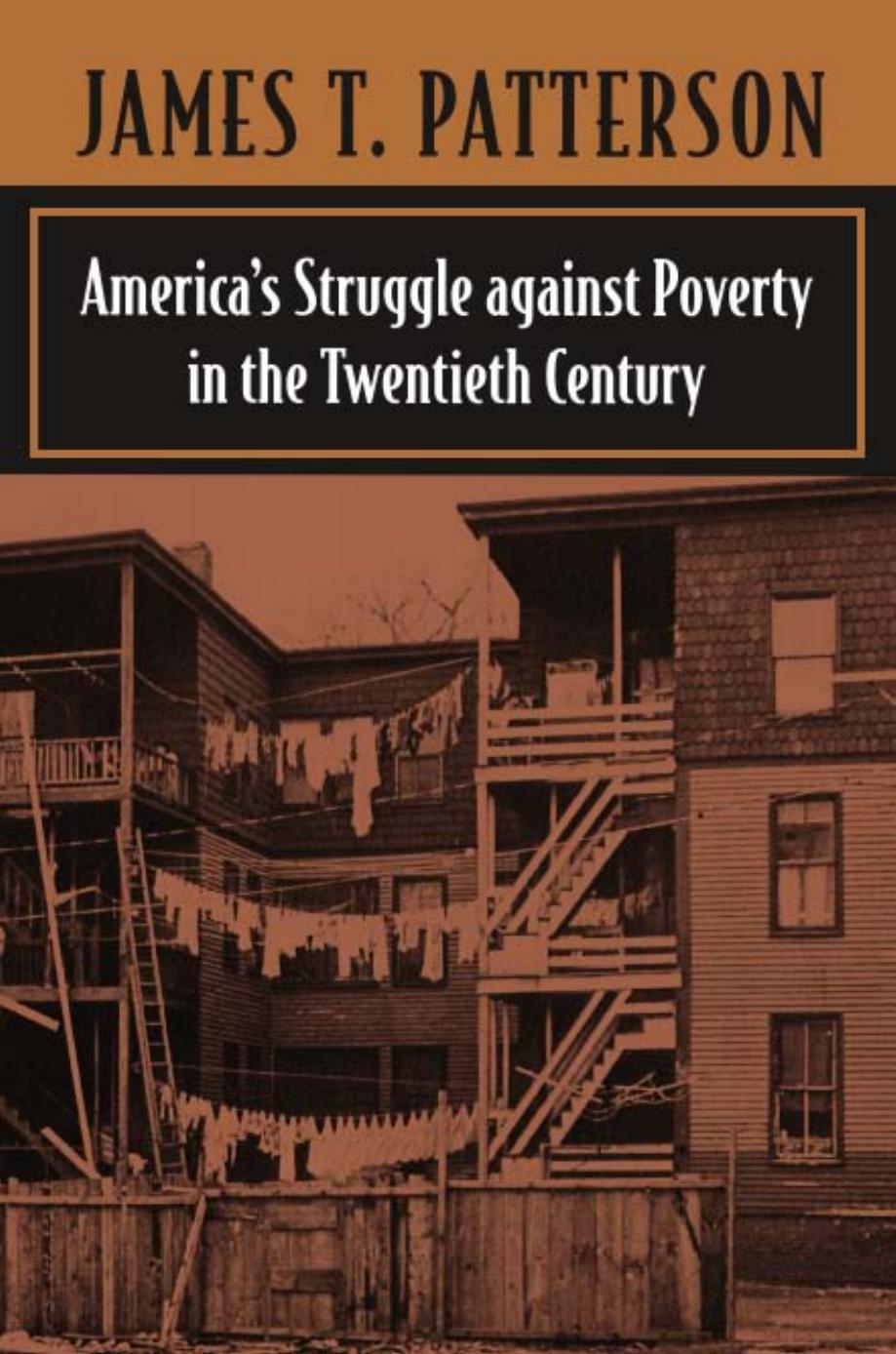
Author:James T. Patterson
Language: eng
Format: mobi, pdf
Published: 2011-08-03T17:49:00+00:00
Such broad explanations were as difficult to document as they had been in earlier periods. Individualism and the work ethic were virtually unmeasurable, and similar values appeared to be just as widespread in other western nations, most of which had more extensive welfare programs. Decentralization certainly played into the hands of local elites and accounted for some of the meanness in application of aid. But decentralization was more an institutional manifestation of such meanness than a cause of it. The racial interpretation relied in part on findings that showed eligibility requirements to be stiffest, and average AFDC payments lowest, in states with large percentages of blacks in the population. But these states, mostly in the South, were also the poorest and least prepared to advocate generous public aid. It was therefore difficult to prove that racial attitudes toward blacks-which grew more liberal in the 1960s-independently accounted for the illiberal nature of public welfare.19
To a limited degree, the Cloward-Piven critique appears correct. Low welfare levels were clearly functional, particularly for employers of poorly paid farm labor. In agricultural areas, especially in the South, harsh application of welfare coexisted with low wages. But Cloward and Piven were more successful in showing the coexistence of welfare and low wages than in proving a causal connection. Many forces, including the work ethic, hostile attitudes toward blacks, and historically disparaging views of poor people helped account for the low levels of public aid in the South.
Cloward and Piven's argument tends also to slight perhaps the most reliable predictor of welfare standards: the state's ability to pay. In the 1960s, as throughout the recent American past, per capita income provided as good a guide as any to state-by-state differentials in standards and requirements. Northern states, wealthier per capita, were better able than southern states to take advantage of matching grant provisions of the categorical assistance plans. Although never a simple one-to-one proposition, the relationship between state per capita income and welfare standards was too powerful to be dismissed.20
But public assistance is only one, narrow way of measuring the role of social welfare. In fact, means-tested programs targeted at the poor, such as AFDC, old-age assistance, general assistance, public housing, and food stamps, made up only 10 to 19 percent of social welfare expenditures between 1965 and 1975. Other programs-especially old age pensions, unemployment compensation, and Medicare-affected roughly four times as many nonpoor as poor, but their impact on the poor was enormous. These programs, in fact, proved that "throwing money at problems" works.
The growth in all social welfare programs was staggering. Expenditures rose between 1965 and 1976 at an annual rate of 7.2 percent in constant dollars, compared to 4.6 percent annually between 1950 and 1965. In 1960 such spending was 7.7 percent of the GNP; in 1965, 10.5 percent; in 1974, 16 percent. By far the largest sums went for nonmeans-tested programs like Social Security, unemployment compensation, and Medicare. But public aid also rose during these years, accounting for 1.3 percent of the GNP in 1950, 1.
Download
America's Struggle Against Poverty in the Twentieth Century by James T. Patterson.pdf
This site does not store any files on its server. We only index and link to content provided by other sites. Please contact the content providers to delete copyright contents if any and email us, we'll remove relevant links or contents immediately.
| Anthropology | Archaeology |
| Philosophy | Politics & Government |
| Social Sciences | Sociology |
| Women's Studies |
The Secret History by Donna Tartt(19312)
The Social Justice Warrior Handbook by Lisa De Pasquale(12228)
Thirteen Reasons Why by Jay Asher(9011)
This Is How You Lose Her by Junot Diaz(6964)
Weapons of Math Destruction by Cathy O'Neil(6372)
Zero to One by Peter Thiel(5876)
Beartown by Fredrik Backman(5849)
The Myth of the Strong Leader by Archie Brown(5553)
The Fire Next Time by James Baldwin(5509)
How Democracies Die by Steven Levitsky & Daniel Ziblatt(5279)
Promise Me, Dad by Joe Biden(5193)
Stone's Rules by Roger Stone(5134)
A Higher Loyalty: Truth, Lies, and Leadership by James Comey(5020)
100 Deadly Skills by Clint Emerson(4975)
Rise and Kill First by Ronen Bergman(4842)
Secrecy World by Jake Bernstein(4806)
The David Icke Guide to the Global Conspiracy (and how to end it) by David Icke(4777)
The Doomsday Machine by Daniel Ellsberg(4558)
The Farm by Tom Rob Smith(4557)
